Application foundation: implemented status
Status: implementation record updated September 23, 2026; earlier acceptance results retain their original scope. This is neither a release nor a security audit. Versión española.
Architecture and evidence
CLI → arveil-app → arveil-core; Flutter calls the same application layer through its Rust bridge. arveil-app coordinates operations and returns structured results; core retains identity, MLS, persistence and delivery primitives. Noise/WebSocket connects to the independent Go relay, which does not hold client E2EE keys. The Flutter client opens encrypted profiles, enrolls by invitation, pairs devices and exports/restores encrypted identity kits through the Rust bridge. Durable progress survives reopening; group creation (verifying the people in it is optional and can come later), paginated history, offline text and sync are implemented.
| Change | Implementation and verification |
|---|---|
| CLI extraction | Application owns conversations, sending, sync, revocation and attachments; chat adapts arguments and presentation. |
| Structured contract | ClientCommand, CommandOutput, ApplicationError, StateChange, MessageReceipt; errors retain partial_result(), local acceptance follows commit and categories do not depend on error text. |
| Delivery correlation | Delivery pending rows include event_id; cursor updates use the maximum of current/new values. |
| Explicit profile configuration | ProfileConfig carries directory, key, TLS authority and expiry policy; the library reads no environment variable. The CLI translates its own. Debug redacts the key, and a malformed key is refused before anything is created. |
| Session lifetime | A second independent open of one canonical directory returns AlreadyOpen, whatever key it offers; sharing means cloning the handle. open opens the database, so a wrong key fails there instead of at the first command. close stops admission, waits for running work and joins the worker, which owns the lock; dropping the last handle takes the same path. |
| Enrollment resumes | One enrollment at a time per profile, with its phase written down as each step becomes durable and the invite kept as a hash rather than a token. A repeat of the same enrollment continues where it stopped and keeps one identity, one mailbox and one route; a different realm or invite is refused and leaves the recorded enrollment untouched. |
| Redeeming an invite twice | The relay records what a redemption produced - token, identity and credential - inside the same transaction that consumes the use, and answers a repeat of that exact triple with the result it recorded rather than a conflict. Another credential for the same identity still conflicts: hash equality is not authorisation. A repeat consumes no further use, and a database written by a newer relay is refused before anything is modified. Mailbox creation now reuses the persisted request and capabilities. The initial KeyPackage batch and its private MLS state are committed together before publication; a lost acknowledgement resends the same bytes, and completion prevents another batch. The relay applies quota after deduplication and never revives consumed packages. |
| The profile key belongs to the platform | 32 random bytes from the operating system, generated in Rust and kept by Keychain or Keystore, without synchronization. iOS/Android use device-bound protection; macOS uses the classic login Keychain and its app access controls. Never derived from a passphrase. A profile whose key is gone is reported, never given a new one: that would answer "nothing here" to someone whose history is on disk. Android refuses cloud backup and device transfer; Apple marks the profile directory excluded on every start. Denied key-store access is reported; no plaintext fallback is used. |
| A panic ends its session | A command that panics is caught at the boundary: the caller gets a typed failure naming the operation, everything queued behind it is answered rather than left waiting, and nothing else runs on that session. A transaction interrupted by an unwind rolls back, since unit_of_work now ends its transaction from Drop. The profile is untouched on disk and opens again once the session is closed. This holds where the build unwinds; a build that aborts on panic ends the process and no contract survives it. |
| Progress while work runs | A bounded projection reaches subscribers as each change is recorded, not when the operation answers: message queued and received, publication, delivery state, transfers, sync, pairing and enrollment steps. A subscriber that falls behind loses events and is told how many, so it re-reads instead of trusting a partial view; the durable result still carries everything. |
| Paged history | QueryHistoryPage takes a conversation, a cursor and a capped limit; identifiers only grow, so a page never shifts when events arrive while a caller reads backwards. Summaries read a count and the newest row instead of every body. Local reads no longer require an enrolled realm. |
| Bounded admission | Work is counted per kind: two syncs, thirty-two other mutations, a hundred and twenty-eight queries. Beyond that a command is refused with a typed Busy that started nothing; slots return when the work finishes, not when a caller walks away. Queries keep room of their own, so they answer while syncs are saturated. |
| Profile executor | Canonical paths share a single-thread runtime that multiplexes network waits without interleaving synchronous MLS/SQLite segments. Events use operation context; the public call remains blocking. |
| Operation exclusion | Sync, network KeyPackage checks and replenishment share one exclusion per profile; BeginPairing/CompleteLink/ConfirmPairing share exclusion, pairing waits/approvals are serialized, and enrollment/recovery share another exclusion. Local queries can progress during network waits. |
| Transactions | SharedConn holds a reentrant mutex throughout transactions, allowing MLS storage callbacks. Client.conn is private. |
| Transport | Carrier bounds connection, handshake, requests and close. Request timeout discards websocket/Noise and requires reconnection. |
| Resumable downloads | Transport failure retains file-pending and .part for subsequent sync; it is not treated as permanent unavailability. |
| Reusable onboarding | Onboarding owns identity, enrollment, grants and pairing; CLI link presents results. |
| Explicit/resumable pairing | Sessions identify start/wait/approve/query/confirm/cancel. Code/expiry are checked before finalization; cancellation after commitment returns AlreadyCommitted. Direct grants and confirmation share persisted Committing→Complete phases with retry-grant identity checks. |
| Cross-process exclusion | ProfileGuard/Application acquire an OS lock on .arveil-profile.lock after canonicalization. CLI also protects legacy commands. Another process receives ProfileInUse; unlocking does not delete the file. |
GUI and CLI may alternate ownership, not access the profile concurrently. Future simultaneous use would require single ownership with IPC, outside the initial plan. Source links follow repository main; merge this local implementation record in the same PR/merge as its source changes, or afterwards. Do not publish a documentation-only PR first with links to files still absent from main: Pages deploys independently and strict MkDocs does not check external targets. Before publication, verify every linked path exists in the target commit; a SHA/tag is useful only if already published and containing those files.
Test provenance
The original foundation cargo test --workspace --locked run passed 72 tests, including a helper process test, with one ignored; demo, interop, q3-capture and phases 1–4 also ran locally. The M3b.0 acceptance flow ran on the device on macOS and on an Android emulator (Android 15, API 35, arm64); no physical phone yet. The platform matrix records the pinned toolchain and the commands. git diff --check passed. These are local-checkout results at that time, not cross-platform or remote CI certification.
Coverage includes overlapping_pairing_confirmations_share_one_mailbox_and_route, direct_grant_completion_resumes_after_network_failure, and late_response_cannot_contaminate_a_second_request. Application lock tests cover normal closure, abrupt termination, distinct profiles and Unix symlink aliases; CLI tests cover legacy protection.
The implementer also reported Clippy and phases 1–4 passing in earlier iterations. The last review did not rerun them; record fresh acceptance against a specific commit before release.
Remaining limits
- The graphical client opens encrypted profiles and supports invitation enrollment, retry and durable setup state on reopen. Pairing and identity-kit interfaces are implemented. Conversation creation, paginated history, text sending and sync are implemented. Contacts, explicit attachments and device management are implemented; encrypted history export/import is implemented. Experimental ZIP/APK packaging exists; physical-mobile acceptance remains pending.
- Only the CLI reads environment variables now, and it still chooses an unencrypted profile when no key is set. Platform key storage is tested on an Android emulator and the ad-hoc macOS build with its login Keychain. Physical-phone and fresh-download acceptance remain pending.
- The Rust bridge runs blocking calls off the UI thread and exposes incremental progress streams. General operation cancellation and full platform lifecycle acceptance remain pending.
- File/membership events need further correlation identifiers. Progress is a projection: changes it does not model reach a caller only in the durable result.
- Actual MLS rejoin/recovery remains pending; the fictitious
recover_conversationwas removed. Sync does not solve desynchronization. - Coordinator succession relies on verified revocations, not automatic election on disconnection.
- The relay applied its pragmas once, so only the connection that ran them had a busy timeout or enforced foreign keys; they now travel in the connection string, and a test holds several connections and checks each. Write transactions also reserve the writer before reading (
BEGIN IMMEDIATE), preventing read-to-write upgrade failures under cleanup or concurrent requests; WAL readers remain concurrent. See the contention regression. Pool sizing itself is still unbounded and remains open. - Identity-kit CLI commands use the application service. Archive legacy commands still need application APIs where required by GUI; the GUI contact API is described below.
Next: Flutter plan, ADR-009.
Invitation enrollment
The invitation form keeps its token only in memory and clears it on completion or profile close. The profile executor answers a typed onboarding snapshot after open and enrollment attempts. Malformed relay/invitation input is rejected before identity creation. UI errors use fixed categories without interpolating paths or remote diagnostics. The tests cover retry, duplicate submission, late-open cleanup and failure-message redaction. This covers the invitation slice of M3b.2. The pairing and identity-kit additions below do not close the milestone: physical-device acceptance and native file-dialog checks remain open. The KeyPackage implementation is recorded below.
Pairing and identity kits (September 23, 2026)
The setup offers invitation, linking and restore. A linked device compares the short code manually before applying its grant; a wrong code cannot finalize it. The new device listens for as long as its code is valid (the relay's rendezvous lifetime, ten minutes by default), because the code travels to the administration device by hand. The code has a Copy code button. Leaving the app to send it is expected: when the linking screen opens or the app returns to the foreground, a code that is still valid is listened for again without asking. If that wait is interrupted before receiving the comparison, Keep waiting also resumes it by hand; an interruption in the middle of the exchange still needs cancellation and a new code. Once the comparison is stored it survives reopening; once confirmation commits, finalization resumes using the same device/mailbox. Cancellation is local and does not revoke authorization already issued by the administrator. The administration screen states this before issuing a grant and keeps the comparison visible afterwards. It also offers Copy server details, the bootstrap the new device asks for first, which otherwise only the relay's log shows. Its network wait is bounded to 90 seconds, and it tells the person to go back to Arveil on the new device meanwhile; cancelling that administration wait is not implemented.
Kit export uses a native save dialog for ciphertext only. The separate secret appears only after a successful save, disappears on leaving/backgrounding the screen, and is never saved by Arveil. Explicit deferral displays the recovery risk. Restore requires an empty profile, the kit, its key and the original relay bootstrap; the user confirms revocation and loss of previous history. Use the latest kit, exporting again after changing devices. Old kits can be refused when the relay already knows a newer manifest. Recovery restores identity, not history or MLS group state.
CLI and GUI share atomic local preparation and a durable recovery journal. A transport failure preserves the same credential and offers resume without reimporting the file. The relay records the exact signed recovery request and its original manifest sequence in one transaction; an identical authenticated retry succeeds, while changed, expired or revoked credentials are refused. This requires the updated relay (schema 4); older relays do not provide lost recovery-response idempotency. Back up before upgrading; a downgrade refuses the newer schema. Rollback warnings persist across restart.
Tests cover UI consent, wrong/expired comparison, cancellation during wait, cancelled export, secret removal on background, atomic preparation rollback, and recovery retries after client/relay restart. Native test reproduction is in the Flutter README. These changes do not publish or replace the existing alpha candidate.
Fresh checks for this change: 87 Rust tests passed (one ignored), Go tests with the race detector, Flutter analysis and 16 widget/unit tests, native macOS and Android-emulator acceptance, phases 2, 3 and 3b acceptance, and strict bilingual documentation build. These are local results; see the platform matrix for the precise scope.
KeyPackage availability and replenishment (September 23, 2026)
The profile screen shows a dated observation of the relay's available one-use keys. Opening a profile reads local state without a network request; unknown availability is distinct from zero. A failed refresh keeps the last observation with a visible warning. Exhaustion blocks other devices starting new conversations with this device, not existing conversations.
At three or fewer available packages, replenishment prepares enough for a target of ten. Public retry bytes and private MLS state commit together before publication. CLI sync and the GUI share that journal and serialize their network operations. After a lost acknowledgement, reopening and retrying sends the same batch; relay deduplication never revives consumed keys. If all keys in that batch were consumed before retry, acknowledgement clears the journal and another explicit replenishment can create fresh keys. A fresh status query after publication supplies the displayed count, allowing for concurrent claims.
Current checks: 89 Rust tests passed (one ignored), Clippy, 20 Flutter
widget/unit tests, and native macOS and Android-emulator acceptance. The local phase 4 script passed,
including actual MLS group consumption and CLI replenishment; its Docker build
was skipped because Docker was unavailable. Native GUI fixture consumption and
platform evidence are described in the platform matrix.
Physical-phone and native file-dialog acceptance remain open. Source version
is 0.1.0+4; the existing alpha candidate is unchanged.
Conversation interface (M3b.3)
Source client 0.1.0+5 adds an adaptive list/detail screen, explicit sharing of
this device's route, comparison of each peer's safety number, verified group
creation, history pages and text composition. Editing routes invalidates the
comparison. Rust validates route sizes, duplicate devices and the exact compared
numbers before pinning contacts. This uses the existing identity/MLS protocol;
it is not an independent security assessment. Since September 27, 2026 the
comparison is optional; see "Talking before verifying" below.
QueueMessage commits the MLS state, event and encrypted outbox before returning
its receipt, without network access. Flutter clears only the accepted draft;
sync publishes the saved envelopes. Creation failures after commit return the
saved group plus a warning so the UI does not create it again. The CLI shares
the same local send transaction. Text is limited to 32 KiB of UTF-8.
History stays queryable during sync. The screen refreshes local projections from progress and completed operations; while foregrounded it also syncs every ten seconds and on resume, with manual retry. This is foreground polling, not push or background delivery. A refresh reconciles the displayed history in pages of 50, retaining the older pages the user opened and stopping if the screen or selection changes. Presentation distinguishes local storage, relay acceptance, unavailable delivery and receipt on this device. It does not claim human reading, authenticated author labels or message timestamps. Contact names and attachment actions are implemented in M3b.4 below; group membership controls remain later work.
Regression coverage includes symmetric route comparison and all-or-nothing contact confirmation, queue/reopen without a relay, post-commit bridge results, blocked sync with responsive history, joined sync callers, cancelled watcher dispatch, stale selections, pagination with arrivals, route-edit invalidation, received text, draft retention and duplicate submission. Lifecycle regressions cover backgrounding during startup and retaining the conversation controller and draft when Flutter rebuilds its route. The platform record gives the native acceptance scope; the Flutter README provides the isolated reproduction command.
Local contacts and recipient selection (first M3b.4 delivery)
Source client 0.1.0+6 adds an address book, local aliases, explicit safety-number
verification and creation from saved contacts. Conversations use participant
names and expose a participant list with identity/device identifiers and
verification/revocation status. These labels do not authenticate individual
message authors and do not synchronize to other profiles.
Routes (including mailbox capabilities) are stored in an additive contact_routes
table inside the GUI's encrypted profile. List projections expose identifiers
and revocation flags, not route capabilities. Saving, renaming and verifying
run through the profile executor; contact, alias, route and optional verification
commit atomically. Editing a route clears the UI comparison. Reimporting the
same device updates its route without duplicating it; an empty import name
preserves the existing alias, while explicit rename can clear it.
Creation accepts saved identity/device identifiers. Rust reloads their routes and requires matching identity/root/device bindings, distinct devices and no locally known revocation before network creation. Until September 27, 2026 it also required verified contacts; see "Talking before verifying" below. The existing post-commit receipt/warning behavior still prevents a retry from inviting the user to recreate a saved group. Up to 16 saved devices can be selected; unknown revocations and stale routes still depend on sync and relay validation.
Existing contacts learned from conversations can be named and verified; if no route was saved, import one before selecting that contact. Alias and verification survive profile reopen. The conversation acceptance helper now exercises this flow before its duplex-text, offline/reconnect and pagination checks. M3b.4 now includes the history and loss/recovery slice described below; physical-device acceptance remains open.
Explicit attachments (second M3b.4 slice)
Source client 0.1.0+7 adds file selection, confirmation, durable local queueing,
explicit download, progress, cancellation and explicit export. The limit is
25 MiB including the 16-byte encryption tag (26,214,384 source bytes). Files
are identified by conversation and event_id, so equal names never select or
overwrite another private copy. Native selectors grant access to the chosen
source/destination; their paths and URIs are not persisted with the message.
Android reads the selected document directly through the
Storage Access Framework
into bounded memory on a worker thread, without the general picker's plaintext
cache or persistent URI grants. The stream limit applies even when a provider
omits or misreports the size. macOS streams the selected file. A provider may
keep its own source copy; Arveil does not control that provider's storage.
The GUI opts into manual attachment handling. Sync receives descriptors but never downloads their blobs automatically. Descriptors, transfer state and ciphertext chunks live in additive tables on the same SQLCipher connection as events and MLS. No decrypted download is written by the GUI. Export checks size, hash and AEAD authentication before returning bytes to the platform save dialog. File-event bodies are stripped at the Flutter bridge: neither capabilities, file keys nor legacy filesystem paths reach history widgets.
Queueing allocates one durable event before network work. Upload resumes from the relay's offset; a lost acknowledgement or application reopen does not allocate another message. The final MLS send unit commits the existing event, outbox and transfer completion together. Retry after that point only synchronizes the stored message. Downloads persist contiguous ciphertext chunks and verify the complete file before exposing export. One transfer runs at a time per profile; history and cancellation remain responsive while it waits for the network. Interrupted files require an explicit resume.
Cancellation is checked after each network wait and prevents later local writes or message commitment. It discards unfinished local data. It cannot recall a committed message or immediately erase bytes already uploaded to the relay; remote cleanup follows its existing expiry policy. A cancelled incoming download can be requested again. A 410 is shown as expired; a 403 is unavailable/access denied, not proof of expiry. Neither action renews capabilities. Legacy CLI-downloaded files remain outside this managed flow.
Rust regressions cover lost upload acknowledgements, interrupted download and encrypted reopen, cancellation during an outstanding request, duplicate names, conversation scoping, invalid sizes/authentication, expiry and denial. Widget tests cover confirmations, retrying the existing event, save-dialog cancellation, changing conversation during file selection and phone layouts. The native attachment scenario uses two profiles and a disposable relay, with in-memory selector substitutes. Actual OS picker dialogs, a physical phone and cross-app release-package acceptance remain separate checks. Android JVM tests additionally cover exact-limit and empty input, oversized unknown-length streams and cancellation before reading.
Own devices and resumable revocation (third M3b.4 slice)
Source 0.1.0+8 adds Manage devices to the profile screen. The local
inventory identifies the current device, root-administrator authority and
known revoked devices. A linked or recovered profile may know credential
hashes without their device identifiers; the screen explicitly counts these
unknown entries rather than claiming a complete inventory. It reports the
local manifest version, not online presence or current relay state.
Only the administrator can revoke another known own device. Confirmation shows its full identifier and explains permanent revocation, deferred relay enforcement and preservation of copies/history already held by that device. Rust rejects self-revocation, unknown identifiers and linked-device authority. Replaying an old link request cannot reauthorize a known revoked device; a new link requires a fresh profile and new device keys.
The manifest, revoked peer flags and revocation journal commit together.
A retry reuses the existing revocation; it never signs a new version merely
because a reply was lost. Each conversation journals its manifest notice
atomically with MLS state and sealed outbox entries. The designated committer
removes the leaf locally; other coordinators must apply removal separately
(the existing CLI chat remove remains available). Regular sync resumes
confirmed revocations, publishes the newest manifest before the outbox and
reuses sealed bytes and delivery IDs. Sync and revocation share one exclusion;
local queries remain available while network work waits.
The UI distinguishes local revocation, relay acceptance, conversations still holding the leaf, queued notices, rejected/expired notices and missing routes. Relay acceptance does not prove peer receipt. Missing routes are reported, not repaired automatically. Known revoked leaves block new sends until removed; offline participants may not yet know the revocation. This does not implement remote erasure, automatic recovery, history import or MLS rejoin.
Rust regressions cover lost manifest/envelope ACKs, encrypted reopen, rejected
authority/targets, rollback of failed local units and a later device link while
publication is pending. Widget tests cover target confirmation/cancellation,
partial inventories, sanitized errors, retry by sync and closing during a wait.
The native devices scenario pairs disposable profiles, revokes offline from
the UI, reopens, synchronizes, checks the revoked handshake is refused and
exchanges text with a remaining peer after MLS removal. Platform results are
recorded separately in PLATFORMS.
The relay in this change atomically stores the signed manifest and revokes its credentials/capabilities. An identical latest manifest is acknowledged again after a lost reply; a different manifest at the same version or an older version remains rejected. Store regressions cover restart, rollback and an interrupted publication left by an older relay. Update the relay together with this client: earlier relays reject duplicate manifest publication with 409, so they cannot complete this lost-ACK retry path.
Encrypted history and loss recovery (fourth M3b.4 slice)
Source 0.1.0+9 adds Historial cifrado to the profile. CLI and GUI share
Application::export_archive / import_archive; the bridge also exposes a
bounded read-only page and explicit attachment export. The archive is an age
file with a fresh, separate secret. It contains neither identity/device private
keys nor active MLS state. The UI reveals the secret only after a successful
save and hides it on leaving/backgrounding, without copying it to the clipboard.
Exports include live and previously imported history. Available managed files are authenticated before inclusion. Pending/cancelled/expired attachments and legacy CLI downloads have metadata only; export never fetches from the relay or reads a path recorded in a message. Imports sanitize filenames and discard old attachment descriptors/paths. Imported file bytes, including empty files, stay in SQLCipher until the user explicitly chooses a destination for a copy.
Import requires the same identity (restore its kit first after loss), validates
the entire archive before writing, and commits records/files in one transaction.
Existing (group_id, event_id) records are retained unchanged and counted as
duplicates. No outbox, live event or MLS state is created. The paginated archive
screen has no composer; imported text is historical data, not authenticated
proof of authorship or delivery. Direction labels include locally queued messages;
the archive does not preserve delivery receipts. Re-export preserves imported
records and available files.
Limits: 64 MiB encrypted input, 10,000 records per archive, 1 MiB per text,
the existing attachment limit below 25 MiB, and a conservative 48 MiB export
payload budget. Oversized exports fail as a whole; no silent truncation or
automatic splitting. v1 archives remain readable; the optional file_present
field distinguishes available empty files in new exports. Older archives with
an empty byte array cannot establish whether an empty file was present.
Rust tests cover a different profile key, wrong identity/secret, tampering,
transaction rollback, duplicate preservation, pagination, re-export and corrupt
attachment refusal. Widget tests cover consent, cancellation, hidden secrets,
bounded reads and sanitized errors. The native archives scenario destroys a
disposable source profile, restores its identity under a new platform-held key,
imports from memory, reopens, checks no resend or automatic rejoin, and exchanges
text through an explicitly created new conversation. It never exports real user
data. See platform evidence for completed native runs.
Profile schema versioning (September 25, 2026)
The profile database records its schema version in PRAGMA user_version, and
arveil_core::schema applies ordered migrations when a connection opens.
Before this, every open reapplied CREATE TABLE IF NOT EXISTS statements. That
adds new tables but cannot change an existing one: the Phase 4 contacts.name
column had been added by editing the table text, so a profile from before it
lacked the column.
- A profile without a version, as written by every build up to
0.1.0+11, is version 0. Migration 1 adds any missing baseline table, addscontacts.namewhen absent and compares every table's columns with the baseline. Any other difference is refused as an unsupported development profile, and the rollback leaves its tables and rows unchanged. - Each migration commits together with the version it sets. A failure keeps the previous version, and the next open resumes from there.
- A profile with a newer version is refused before the connection writes
anything, including the journal-mode pragma. The application reports
ProfileTooNew; the GUI asks for an app update and states that the profile was not changed. A wrong key is still reported as before. - Builds up to
0.1.0+11do not read the version. Version 1 changes no existing table beyond that repair, so they still open an adopted profile, but a later migration may not stay compatible with them. Do not install an older app over a newer one; Android already refuses a lower build number. - The baseline texts (
MLS_SCHEMA,CLIENT_SCHEMA,DELIVERY_SCHEMA) are frozen. A schema change is a new migration at the end of the list, with a test that starts from the previous version.
Evidence: the schema tests in arveil-core cover new, adopted, repaired,
unsupported, newer (plain and SQLCipher), negative-version, interrupted and
resumed, and reopened profiles. arveil-app checks that Application::open
refuses a newer profile and releases it, and a Flutter test checks the message.
A local run used real main binaries to create an encrypted and a plain CLI
profile with a live MLS conversation. The new CLI adopted both and the
conversation continued without loss. The old CLI still read the adopted
profile, and a copy marked as version 2 was refused without byte changes.
Workspace tests, Clippy, the MLS spike and the demo and phase scripts passed.
Upgrading packaged apps with populated profiles on Android and macOS is still
an acceptance step of the client redesign.
Message senders and times (September 25, 2026)
Every history event now says who wrote it and when this device recorded it.
Migration 2 adds sender_device and sender_identity to events. Both are
nullable, so builds up to 0.1.0+11 still read and write a version 2 profile;
a CLI run confirmed it.
- Processing an MLS application message (text or attachment announcement) stores the device behind the sending leaf, which MLS has just authenticated. It also stores the identity this profile knows for that device: its own for this device and the devices it authorized, or a peer's from that conversation's roster. Messages this device writes are stored as its own.
- Reading history resolves what was unknown on arrival: a device learned later is named from the roster at read time. Events recorded before version 2 keep empty senders, except that this device's own sent kinds are its own. A received row is never attributed by guessing.
HistoryEventViewgains four fields:created_at: Unix seconds when this device recorded the event, which is arrival for received events and creation for sent ones. It is not when the sender wrote it; the protocol does not carry that time.sender_identity: the identity that wrote the event, when known.sender_label: the local contact name or a short identifier, absent for own events and for unknown senders.own: written by this identity, from any of its devices.- The conversation screen:
- Aligns own messages to the own side, including those from another device of the same identity.
- Names the author of received messages when more than one other identity writes in the conversation.
- Shows the recorded time.
The complete redesign of this screen is a later step of the client plan. - Imported history records carry their time but not yet their sender. Changing the archive format is a separate step.
Evidence:
- Core tests cover the sender round trip, the device-to-identity lookup and migration 2.
- An application test uses a real in-process MLS group. It covers another identity learned only after its message, another device of the same identity, older rows and a contact rename.
- The bridge conversion and Flutter widget tests cover the new fields, author naming, own-side alignment and time formatting.
- An upgrade run from
mainbinaries adopted a profile to version 2. The next received message carried the peer's device and identity, the next sent message was own, earlier rows stayed empty, and the old CLI still read the profile.
Conversation summaries and unread counts (September 25, 2026)
Each conversation row now carries three things: its newest event, how many messages are unread, and when the conversation was last active. The bridge orders the GUI list by that activity. The application layer keeps the order in which conversations were started, because the command line lists them that way and the Phase 4 acceptance script picks conversations by position.
- Migration 3 adds
read_markers, one cursor per conversation. Conversations that existed before it count as read up to their newest event, so an update does not turn old messages into new ones. mark_read(group, cursor)only moves a marker forward, and never past the newest event. A stale screen or an overreaching caller therefore cannot hide what arrives later. The call returns the marker in effect and the remaining unread count.- Unread counts the events after the marker that another identity wrote. It never counts this device's own kinds or messages from another device of the same identity. Received rows from before sender attribution count when they come after the marker.
ConversationViewgains three fields:last_event: the kind, a one-line text preview of at most 120 characters, the attachment name, the sender label, whether it is own, the time and the delivery states.unread: the number of unread messages.last_activity: the time of the newest event, or when this device started keeping the conversation.
GUI rows are ordered by activity. Event order breaks ties within a second, and a full tie keeps the start order. As in history, only text bodies cross the bridge. - The GUI marks the open conversation read up to the newest event it shows. It does so only in the foreground and once per cursor. A failure leaves the marker where it was, and the next read retries. Rows show the preview (with the author in groups and "Tú:" for own messages), the time and an unread count that screen readers announce as part of the row.
Evidence:
- A bridge test covers ordering by activity and its tie-breaking.
- Core tests cover markers that only move forward and stop at the newest event, unread counts that exclude own kinds and own devices, and migration 3.
- An application test goes through the executor. It covers the start order, previews, stale marks, markers after reopening, and new messages becoming unread again.
- A bridge test checks that the preview cuts multibyte text safely, stays on one line and never exposes a non-text body.
- Flutter tests cover marking once, row previews and unread counts.
- An upgrade run from
mainbinaries adopted a CLI profile to version 3. What it held before counted as read, the first message after the update was unread, and the old CLI still read the profile.
Kit reminder, device notices and sync status (September 25, 2026)
- Identity kit state.
- Migration 4 adds
kit_exports. Exporting a kit records it as pending, together with the manifest sequence it carries. Onlyconfirm_kit_saved, which the GUI calls when the user states that the file and its key are stored, makes it the saved kit. - The setup status reports
kit_saved_atandkit_staleon the administration device. A kit is stale when the device manifest advanced after it was saved. - The ready screen reminds the user when no kit was saved or the kit is stale. "Más tarde" hides the reminder until the profile is opened again.
- The CLI export does not confirm anything.
- Device-change notices.
- Migration 5 keeps the active device set of each contact manifest this profile accepted. The next accepted manifest yields how many devices it added and removed. The first manifest learned is a baseline and announces nothing.
- A changed manifest, whether it arrived through a group or from the relay,
records a local
devices-changednotice in every conversation shared with that identity. The notice commits in the same transaction as the manifest. - Notices carry counts, never device identifiers. They have one stable identifier per conversation and manifest sequence, never count as unread and are left out of history archives.
- The GUI shows a centred note. It points to the verified identity's
signature when the contact is verified, and suggests comparing safety
numbers otherwise.
chat historyin the CLI prints notices on one line. - Sync status. The conversation controller keeps a presentation-only projection: never synced, syncing, synced (with the time of the last success), offline or refused. Only a typed transport error counts as offline; any other failure comes from a server that answered. The screen shows one line about the last successful sync and never claims delivery.
Evidence:
- An application test goes through the executor. It covers pending and confirmed kits, a device authorization that makes the kit stale, and a new confirmation that clears it.
- Core tests cover device changes from real contact manifests (baseline, a repeated manifest, a linked device, a revoked device), notices never counting as unread and stable notice identifiers.
- An application test with a real in-process MLS group covers a baseline manifest with no notice and a linked device announced in both shared conversations, with no unread count and no duplicate on repetition.
- Flutter tests cover the kit reminder and its confirmation, notice wording and the verified and unverified variants, and the sync projection distinguishing offline from refused without exposing diagnostics.
- A CLI run against a real relay: bob learned alice's baseline manifest with
no notice. After alice linked a laptop, bob's history showed one notice for
one added device, and a further sync did not repeat it. An upgrade run from
mainbinaries adopted profiles to version 5, and the old CLI still read them.
Authors in the encrypted history (September 25, 2026)
Exported history records now name their author when the exporting device knew it, as it does for live history: the identity stored with the event, the roster identity for its device, or this identity for what it sent.
- The author is an optional
sender_identityinside archive format version 1, following thefile_presentprecedent, instead of a new format version. A record without an author writes exactly the bytes it wrote before. Earlier archives import without authors, and builds that predate the field ignore it. - Migration 6 adds
sender_identitytoarchived_events. Importing keeps the first copy of a record, so a later archive naming another author for the same record is a duplicate and changes nothing. An author that is not a 32-byte identity is refused, and nothing from that archive is imported. - The encrypted-history page and imported conversations show the author by local name or short identifier, marked as the archive's account ("según el archivo"): an archive is user-supplied history, not proof of authorship.
- Device-change notices never enter an export. The exporter refuses unknown kinds, so leaving notices out also keeps exports working after a notice.
Evidence: a core test reads and writes the format in both directions. An
application test exports authored, own, unattributed and notice rows,
imports them into a restored profile, checks labels in the archive page and
imported conversations, confirms that a later conflicting author is ignored,
and refuses a malformed author. A Flutter test covers the label. The Phase 2
archive flows pass with the CLI, and an upgrade run from main binaries
adopted profiles to version 6.
Design foundation (September 25, 2026)
The client now draws with its own design system instead of a seeded Material scheme and system fonts.
- Fonts. Newsreader, Instrument Sans and IBM Plex Mono are bundled
unmodified (SIL OFL 1.1) from
google/fontsat a recorded commit, with their SHA-256 inclients/flutter/assets/fonts/README.md. Their licenses are registered on Flutter's license page. Nothing is fetched at runtime. Weights of the variable fonts are set through their axes. - Tokens.
ArveilColorscarries the plan's light and dark tokens, plus avatar and sender colours chosen stably by identity.lineStrongwas added for control borders, andonDanger,dangerSoftandonDangerSoftfor error states.ArveilThememaps the tokens onto Material, and the app follows the system light or dark setting. - Components. Brand mark (from the icon's own path), avatar, verified mark, unverified chip, unread badge, delivery icon, date separator, notice chip, status banner, sync line, safety-number grid, empty state, settings group and row, chat bubble with runs, conversation tile and composer. Icons are Material's outlined set, already bundled with Flutter.
- Launch screen. On Android, the icon's pine green shows with the ribbon mark, through the system splash API from Android 12. Behind the first Flutter frame the window uses the ground colour, so nothing flashes white. macOS has no launch screen.
Evidence:
- A unit test checks WCAG AA contrast for every text/background pair and 3:1 for control borders, in both themes.
- Goldens of a conversation sheet and an identity sheet, in light and dark, render the bundled fonts and icons. The comparator tolerates at most 0.5 % differing pixels.
- Behaviour tests cover the delivery mapping (never "read"), initials, spoken labels, and components fitting a 390 px phone at 200 % text.
The existing screens only pick up the new colours and type; the redesigned screens are the C packages of the client plan.
Spanish and English (September 25, 2026)
The client shows its interface in Spanish or English, following the system language.
- Messages. Every visible string lives in
clients/flutter/lib/l10n/app_es.arbandapp_en.arb.gen-l10ngenerates the code, which is committed; Spanish is the template. Counts use ICU plurals and dates follow each language's order: "20/9/2026" in Spanish and "Sep 20, 2026" in English, with the month abbreviated because digits alone read two ways. The clock follows the system's 24- or 12-hour setting ("18:30", "6:30 p. m.", "6:30 PM"). Code countdowns show minutes and seconds ("Expires in 9:59.") and screen readers hear whole minutes, which change once a minute. - Choosing the language. English is used only when the system prefers it. Otherwise, including a system set to Catalan, Galician or Basque, the interface is in Spanish. D1 will add a manual choice.
- Code outside widgets. The profile session, the conversation controller
and the native file dialogs read
currentStrings, which the app keeps in step with the language in use. A component pumped outside the app falls back to the same strings. - Glossary. The interface no longer shows protocol names: it says server instead of relay, identity kit, keys for new groups and encrypted history, as the client plan sets out. Technical terms stay in diagnostics and operator documentation.
Evidence:
- Widget tests keep finding the Spanish text, the normative language,
through
test/flutter_test_config.dart. test/l10n_test.dartchecks that both ARBs carry the same messages with the same placeholders, the locale resolution, and the whole app in English, including text produced outside widgets.- CI regenerates the localizations and fails if they differ from the committed ones or if any message is left untranslated.
Adaptive navigation and shortcuts (September 25, 2026)
A ready profile opens the main navigation: Chats, Contacts and Settings. Without an identity only the welcome and enrollment show, and a finished enrollment goes straight to Chats.
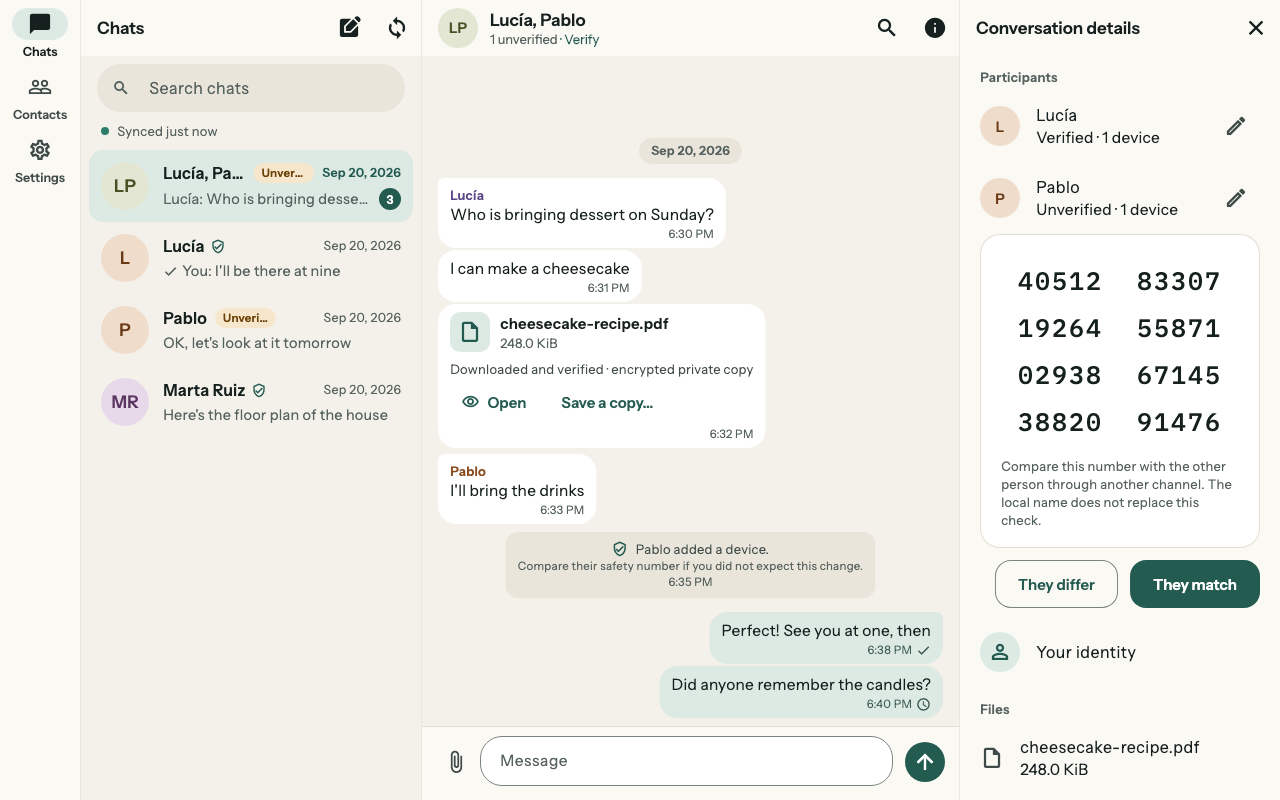
- Sizes. Below 600 dp there is a bottom bar, and an open conversation takes
the whole screen without it. From 600 to 839 dp the structure is the same
with wider margins. From 840 dp a side rail sits beside the list and the
conversation, which share the window. The breakpoints live in
WindowSize, in the design system. - State. Each destination is built on its first visit and then stays mounted: the conversation keeps syncing and keeps its draft while contacts or settings are on screen, and when the window changes size. Back closes the conversation first and, from another destination, returns to Chats.
- Settings. It gathers what the profile screen used to show: devices, encrypted history, keys for new groups, the identity kit, linking another device and "Close profile". The kit reminder and the recovery warning appear above the chat list, and "Save kit" leads to the kit panel in Settings.
- Desktop shortcuts (⌘ on macOS, Ctrl elsewhere): ⌘N opens a new chat, ⌥↑ and ⌥↓ move to the previous or next chat, ⌘, opens Settings and Esc closes the conversation; dialogs close on Esc by themselves. Esc does not close screens with forms, so nothing typed is lost. On desktop Enter sends and Shift+Enter does not; while an input method is composing, Enter confirms the composition. On phones Enter inserts a line. ⌘K will come with the chat search (C2).
- Focus. The rail, the list and the conversation are traversal groups, so Tab moves from the rail to the list and then to the conversation.
Evidence:
test/navigation_test.dartwalks the app at 390×844 and 1280×800: bar or rail, full-screen conversation on phones, back, resizing without losing the draft, the shortcuts on macOS and Linux, Enter on macOS, Windows and Android, and Tab order.- The kit, recovery, pairing and key tests follow the new path to Settings.
Chat list (September 25, 2026)
The chat list now uses the design system's components.
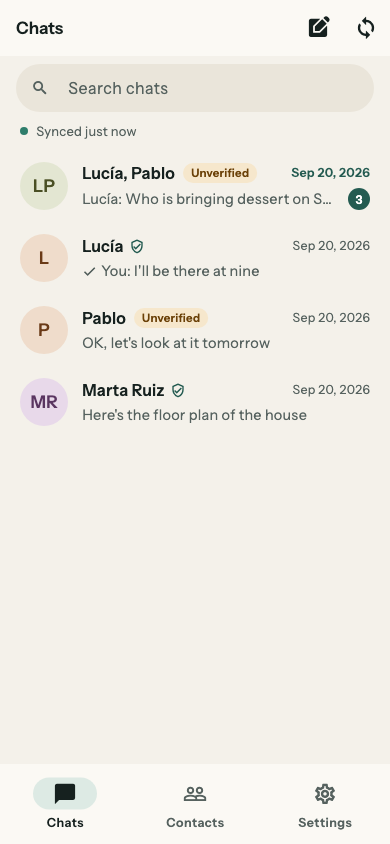
- Rows. Each row has an avatar, the name, a preview of the newest event, the time, unread messages and, when this device sent the newest message, its delivery state (never "read"). The avatar takes the other person's tone or, in a group, the group's. The verified mark shows when everyone else was verified, and "Unverified" when anyone was not. The time is today's hour, "Yesterday" or the date.
- Search. It filters by the conversation's name or anyone's in it, ignoring case and accents, and says when nothing matches. ⌘K (Ctrl+K outside macOS) puts the cursor in it, closing a conversation that covers the list on a phone; Esc clears it.
- Header. The sync line marks with a dot whether the server was reached. Below come the notices: an identity kit that is missing or out of date, with "Save kit" and "Later"; the warning after a recovery; and being offline or refused by the server.
- Empty. Without conversations the list explains how to start and offers "New conversation"; on desktop, the pane with no open conversation uses the empty state as well.
ArveilColors.offalls back to the default tokens for the current brightness when a widget is shown outside Arveil's theme, as in an isolated test.
Evidence: test/chat_list_test.dart covers rows (avatar, verification,
delivery and unread), times, accent-insensitive search and clearing it, ⌘K
and Esc on macOS and Windows, the empty state and its action, the kit
reminder, and the list at 200 % text on a phone.
Conversation (September 25, 2026)
The open conversation now uses the design system's components.
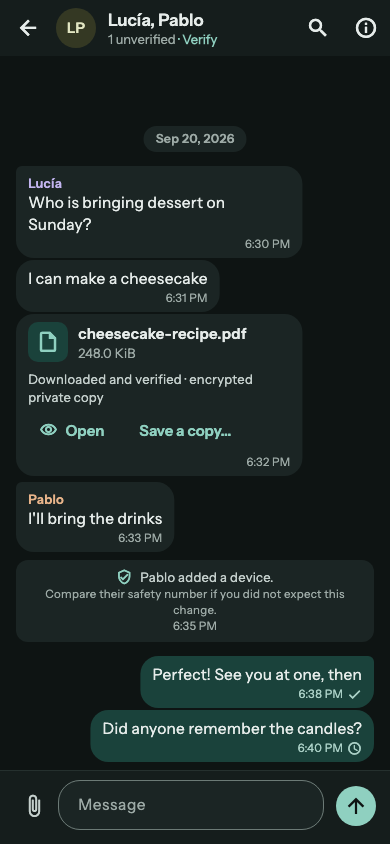
- History. Messages are bubbles as wide as their content. Messages from one author less than ten minutes apart on the same day form a run: only the first bubble has the tail and, in a group, the author's name in their colour. A separator says "Today", "Yesterday" or the date when the local day changes. Device notices sit centred and always stand alone. Loading earlier messages is kept.
- Delivery. Each bubble shows the time and, for what this device sent, a status icon. A long press or a secondary click opens its details: when it was recorded here, the state of each mailbox (accepted by the server, pending, refused or expired, never "read"), and copying the text.
- Attachments. They sit in a bubble with an icon, name, size, state, progress and the same actions as before. The bubble does not merge its semantics, so each button stays reachable on its own.
- Header and details. The header shows the avatar, the name, and whether the other person was verified or how many people the group has. The details list each person with their verification and devices, your devices, and the files in the loaded history. From 1200 dp they stay in a panel beside the conversation; on phones they open in a sheet and elsewhere in a dialog.
- Offline. In a single column the conversation shows the offline or refused notice, which two columns already show above the list. The composer is the design system's, with the same limits and without the keyboard learning what is typed.
- On desktop each column has its own bar: the list with its actions, the conversation with its header, and the details with their title.
Evidence:
test/conversation_view_test.dartcovers runs and separators, names on the first message of each run, per-mailbox details and copying from a secondary click, the panel from 1200 dp and the dialog below it, the offline notice on phones, and an empty conversation.- The component goldens were regenerated with bubbles sized to their content.
Contacts, verification and settings (September 25, 2026)
- Contacts. The list starts with "Your contact route", which shows and copies this device's route (it leaves the chats bar). Each contact has an avatar, the verified mark or "Unverified", and how many devices are available. With no contacts, it offers to add one.
- Verification. Adding a contact or opening its details shows the identity and the safety number in the four-row grid, with "They match" and "They differ". While adding, "They match" saves the contact as verified; on a saved contact, it verifies it. "They differ" explains it must not be verified and that the route should be asked for again through another channel. Saving unverified is still possible and never verifies.
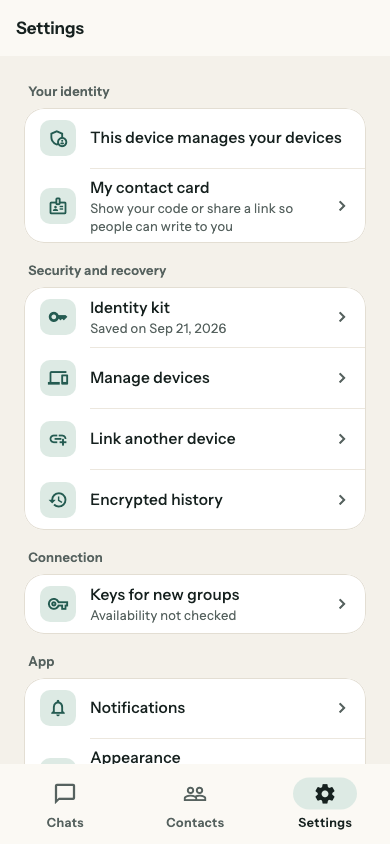
- Settings in sections. Your identity (whether this device manages or is linked, and your route), Security and recovery (identity kit, devices, linking another device and encrypted history), Connection (keys for new groups) and App (updates, appearance, diagnostics and "About Arveil"), then "Close profile". Each row states where it stands: the kit not saved, out of date or the date it was saved, drawn as a notice when it needs attention, and the last key check.
- About Arveil. The version, who makes it (KaiCorp Labs), and links to the website, the privacy policy in the reader's language and the source code, which open in the browser (or are copied when there is none), plus the open-source licences the libraries and typefaces require. The welcome screen opens it too, before any identity exists.
- Screens of their own. The kit, linking and keys open on their own screen with a bar, showing the profile's activity and errors there. "Save kit" in the list's reminder opens the kit screen directly. Devices and encrypted history use the design system's margins, cards and notices.
SettingsGroupis now aMaterial, so tapping its rows shows feedback.
Evidence: test/settings_test.dart covers the sections and kit states (saved,
not saved and linked device), each screen with its bar, the own route from
contacts, the list with verification, the empty list, and adding a contact
that is saved verified only after "They match". The kit, key, linking and
contact tests follow the new path.
Welcome and enrollment (September 25, 2026)
- Welcome. With the profile closed, the brand mark, what Arveil is in one sentence, the note on the profile key and "Open profile" show.
- Three ways in. A profile without an identity asks how to start: join with an invitation, link with another device, or restore from a kit. Each has "Back to setup" at the top.
- Invitation in two steps. First the server details, then the invitation, each step validating its own field under a "Step 1 of 2" indicator. "Back" keeps what was typed. An enrollment left half-done resumes as before, with both fields on one screen, the saved state and the typed errors.
- Kit after enrollment. When an identity becomes ready on this device as an administration device without a current kit, saving the kit is offered before entering ("Save kit" opens its screen), with the risk of postponing in view; "Later" goes to Chats, where the reminder stays until it is saved. Reopening a ready profile goes straight in.
ProfilePagemoves tolib/src/onboarding.dart;main.dartonly starts the app.
Evidence: test/onboarding_test.dart covers the welcome with the mark, the
three ways in and back, the two steps keeping the server, the kit offer with
"Later" and with "Save kit", and reopening without an offer. The resumable
enrollment test walks the steps, and the restore test goes through the offer.
Appearance (September 25, 2026)
Settings → App → Appearance gathers the first version's personalization, with a preview that changes at once.
- Theme: system, light or dark.
- Accent: pine (the brand's), lake, plum, clay, moss and slate, each with a
light and a dark variant. The contrast test walks every pair of the interface
with each accent in both themes; there is no free colour picker because it
could not guarantee that. The test now includes muted text and the accent on
a selected row, which is why pine's dark tint moved from
#1D4740to#1A423B. - Conversation background: plain, arcs, dots, waves or diamonds, drawn by
the app in the decorative line colour. Bubbles, dates and notices stay
opaque on top. The motif sits behind a
RepaintBoundaryand is not repainted when messages scroll. - Text size: 90 % to 130 %, multiplied by the system's.
- Language: the system's, Spanish or English.
The preferences are global and read before the profile opens, because the
welcome already uses the theme. They are saved as appearance.json in the
app's support directory, outside profile/, by writing a temporary file that
then replaces the old one. They hold only those five values: no identifier,
name, route or image. A missing or unknown field takes its default without
affecting the others, and an unreadable file leaves every default. If saving
fails, the change stays in effect until the app closes.
Evidence: test/appearance_test.dart (contrast of each accent in both themes,
field-by-field reading, atomic replacement and a broken file, immediate theme,
accent, size and language changes, and a background that scrolling does not
repaint) and the golden test/goldens/wallpapers.png with two backgrounds in
light and dark.
Automated accessibility (September 25, 2026)
- Messages. Each bubble reads as one sentence: who, when and what ("Lucía, 18:40: Coming?"), and for what this device sent, its state ("… Accepted by the server"). The long-press action opens its details from a screen reader too. Avatars are decorative.
- Motion. When the system asks for reduced motion, screens appear without
sliding or scaling (
MotionAwareTransitions). - Large text. At 200 % text the main screens do not overflow: the
"Unverified" chip gives way when space runs out (
NameLine), the enrollment bar shows a described icon instead of "Close profile", and a row's name uses all the width available instead of half. - Touch targets. The main phone screens meet Flutter's 48 dp and labelled tap target guidelines; the accent swatches and the composer field now measure 48 dp for it.
- Settings. Each row is a stop of its own with its title, state and action, and each group's title is a separate heading. Before, a group with a single tappable row, such as "Connection", read as one tappable heading. The text size control says what it sizes and its value once ("Text size, 100%"); the value also shows next to the control.
Evidence: test/accessibility_test.dart. The TalkBack review is in the
platform matrix; VoiceOver is still untested.
Secret-free diagnostics (September 25, 2026)
Settings → App → Diagnostics shows a report before it leaves the device and
saves it through the native dialog (arveil-diagnostic.txt).
- What it holds: the build's version and commit (injected by
scripts/package_clients.py; "local build" otherwise), system, language, whether the profile is open, the enrollment stage, whether the device manages or is linked, the number of conversations and active devices, the kit's state, the level of keys for new groups, and the codes of the latest failures. - Failure codes: kind and operation ("transport:sync"), never the message or reason, which may carry paths, addresses or remote text. An operation that is not a plain name is recorded as "unknown". The last twenty are kept, in memory only.
- What it never holds: keys, identifiers, routes, addresses, invitations, names or content. The report uses English keys, like the rest of the technical diagnostics.
Evidence: test/diagnostics_test.dart builds a profile whose identifiers,
names, messages, route, safety number, server, system paths and error
reasons are marked as secrets, and checks that none appears in the report
while the counts do; and that the screen saves exactly what it shows.
Screenshots and closing the redesign (September 25, 2026)
The main screens have full goldens on phone (390×844) and desktop (1280×800),
in light and dark (test/goldens/screens_test.dart), with an invented circle
of people and messages and fixed local times, so they look the same in any
time zone. The documentation's screenshots are copies of those goldens:
scripts/update_screenshots.sh regenerates them and a test checks they do not
drift. Since October 1, 2026 the goldens are rendered in English and Spanish
(test/goldens/screens/en/ and es/), include the contact card, its code and
an incoming contact link, and scripts/readme_media.py frames the README
pictures and the animated tour from them (docs/assets/readme/); a second
test checks those were framed from the current goldens.
test/hygiene_test.dart checks that outside design/ and l10n/ no colour
or visible text is written by hand (only Colors.transparent and the
technical arveil-bootstrap:v0:… format are allowed). The app name and the
language names also come from the ARBs.
Search within a conversation (September 25, 2026)
- Rust.
Application::search_historyfinds the text messages of one conversation that contain the requested text, ignoring case and accents, newest first. Each call reads at most 5,000 events (MAX_SEARCH_SCAN) and says where it stopped, so a long history answers in bounded time. Notices, attachments and other conversations are left out. The bridge exposes it assearchHistory, shaped like a history page. - Interface. The search button in the header, or ⌘F (Ctrl+F outside macOS) on desktop, swaps the history for a field and the results: who and when, and the text. Tapping one opens its details. "Search further back" continues when the reading stopped before the start, and the screen says when nothing matches. Escape, the close button or back on a phone return to the conversation.
- Jumping to the message inside the history is left for later: it needs the surrounding pages loaded.
Evidence: two tests in arveil-app (case- and accent-insensitive matching,
text of that conversation only, continuing past the limit and reading at most
5,000 events per call) and test/conversation_search_test.dart (results, no
match, searching further back, ⌘F and Escape on macOS and Linux, and back on a
phone).
Read visibility and device-state refresh (September 26, 2026)
Local history reads and synchronization no longer advance the read marker on their own. The conversation reports the cursor of its displayed history after the frame, only while Chats is visible, its route is current, search is closed and the app is active. Messages received behind Settings, Contacts, search or another screen remain unread until the history is shown again. Sync continues while navigating, and a delayed query cannot mark a hidden conversation read.
Device operations refresh the shared profile snapshot after completion, including a network error after a durable local revocation. Settings and the chat-list reminder then show that the saved identity kit needs updating. The refresh also happens if the user leaves the device screen before completion.
Widget regressions are in test/conversation_visibility_test.dart and
test/settings_test.dart. The native conversation scenario now opens the full
application and uses its current navigation and safety-number grid; it checks
the Rust unread count while Settings hides an incoming message and after the
conversation is displayed again. These checks do not establish physical-device
or package-upgrade acceptance.
Naming people who have no local name (September 26, 2026)
Names stay local: each profile names its contacts, the name never leaves the device and never authenticates anyone. What changed is how visible that is. Before, a person without a name appeared as eight hexadecimal characters, which the first beta testers read as a missing feature.
- Rust reports, for each person in a conversation, whether this profile named
them (
PeerView.named), rather than leaving the app to guess from the label. - A person without a name reads Unnamed · a1b2c3d4 in the chat list, the conversation title and Contacts, with the person icon instead of initials.
- An open conversation with someone unnamed shows a notice with Name this person, which opens a dialog that says the name is only seen in this profile. With several people unnamed, Name them opens the details.
- The conversation details name the unnamed and rename the named.
- A new conversation from pasted routes asks for a local name per person, filled with the name a saved contact already has. A failure to read contacts leaves the fields empty and never blocks the conversation.
A shared name, chosen by each person and sent to their conversations, is a protocol change and is proposed separately in ADR-011.
Regressions are in test/names_test.dart, and the desktop conversation
screenshots show the rename action in the details.
Talking before verifying (September 27, 2026)
Connect first, verify when you want. Verification used to gate every new conversation, which either blocked people (whoever shared their route could not see the safety number until they also had the other person's) or taught them to tick "We compared" without comparing. Comparing is now optional when a conversation is created and stays available from the conversation. The protocol, the relay and the wire format do not change.
- Pasted routes. Preparing still shows each route's safety number and a local name field. Each person has an optional We compared this number through another channel and it matches, and the conversation is created without it. Only the people marked are pinned as verified; the rest are saved as unverified contacts, with the name typed. A route for an identity already verified under another root is still refused, compared or not, and nothing is saved. Leaving a verified person unmarked does not unverify them.
- Saved contacts. The picker also offers unverified contacts. A contact still needs a saved route and a device not known to be revoked, and that route must still match the contact's identity, root and device.
- Visible, not blocking. While someone else in the open conversation is unverified, the line under its name reads Unverified · Verify, or 1 unverified · Verify in a group. Tapping the header opens the details. Nothing is modal, the composer stays available and the Name this person notice is unchanged.
- Verifying from the details. Each unverified person shows the safety number in the usual grid with They match and They differ. They match runs the same check as Contacts; They differ warns and verifies nothing. Whoever received the invitation has no saved route for the other members, only the roster: the number is computed over the root the roster named, and verifying pins that root. Every member met in a conversation already has an unverified contact from the roster; if one is missing, verifying first saves it from the roster's root.
- Rust API.
create_verified_conversationis nowcreate_route_conversation, with an optional compared number per route (ConversationRoute); the bridge'screateConversationtakes oneString?per route.PeerView.safetyNumbercarries the number to compare with each person.create_contact_conversationno longer requires verified contacts. The CLI does not change:chat startnever required verification.
Evidence: the arveil-app tests cover an unverified saved contact reaching the
network step, pasted routes saved unverified unless compared, a compared route
pinned as verified, a route for an identity verified under another root refused
without saving anything, and verifying a member known only from a roster, with
and without a contact. test/verification_test.dart covers the header line,
verifying from the details on a phone and beside a wide conversation, They
differ, a failed save and groups; test/conversations_test.dart,
test/names_test.dart and test/contacts_test.dart cover creating without
comparing and unverified contacts in the picker. The accessibility checks now
open a conversation with someone unverified. The conversation acceptance helper
chooses an unverified saved contact, verifies it afterwards and verifies the
creator from the receiving profile. The phone and desktop conversation
screenshots show the new line and the comparison in the details.
QR codes and links (September 27, 2026)
ADR-012 replaces the long strings people carried between apps. One payload travels as a QR code, an https link or a paste, for joining, linking a device and adding a contact.
- Joining.
arveil-relay inviteprints alink:line and, on a terminal, its QR code. The enrollment field takes the link, or a whole message that contains it, and fills the server details and the invitation. A code that is not an invitation, a newer one, a damaged one or two at once each say so. - Linking a device. Settings › Link another device shows a QR code, a countdown and Copy link. The new device chooses Link with my other device and scans it (Android) or pastes the link. Both show the same number while the new device waits; the device with the root asks Link "Pixel 8 · Android 15"? and signs nothing until Link. Decline stops the new device at once. A scanned code is applied when the grant arrives; a pasted one is also confirmed on the new device. The older flow, where the new device shows a code, is one tap away on both screens and is now confirmed the same way.
- Contacts. Contacts › My contact card offers Show my code (a QR valid ten minutes, once, while the screen is open) and Share my contact (a link through the system share sheet, valid 30 days, listed and revocable), with an optional name for the card. Scan a code (Android) and Open a contact link show who the card names and the safety number before Start talking. Scanning in person verifies both people; the details say Verified in person. The checkbox that marked a number as compared when creating a conversation is gone: verification is done from the details or in person.
- Requests. A conversation from someone who is not a chosen contact waits under Requests at the top of the chat list: "Ana wants to talk to you", with which shared link was used or that none was, and Accept or Decline. Declined conversations disappear and deliver nothing more.
- Opening links. On Android, links to
arveil.kaicorplabs.com/join,/linkand/contactopen the app directly; both platforms take thearveil:scheme from the page's Open in Arveil button. Each link fills the right screen and waits for a tap. - Camera. Android only, requested after Scan; frames are read in the Rust core and nothing leaves the device. Without a camera, or with the permission refused, pasting stays available.